
September: Smokestacks
Visconti, Fascism, "Puttin' on the Ritz," One Battle After Another, a magic carpet to Bavaria, the dark history and composition of film stocks, and are Sinners and Xanadu the same movie?

What follows is a compendium of notes I’ve been keeping in my notebook for the last month, since I went back to school. Maybe I will do this every month? Or maybe not. Enjoy!
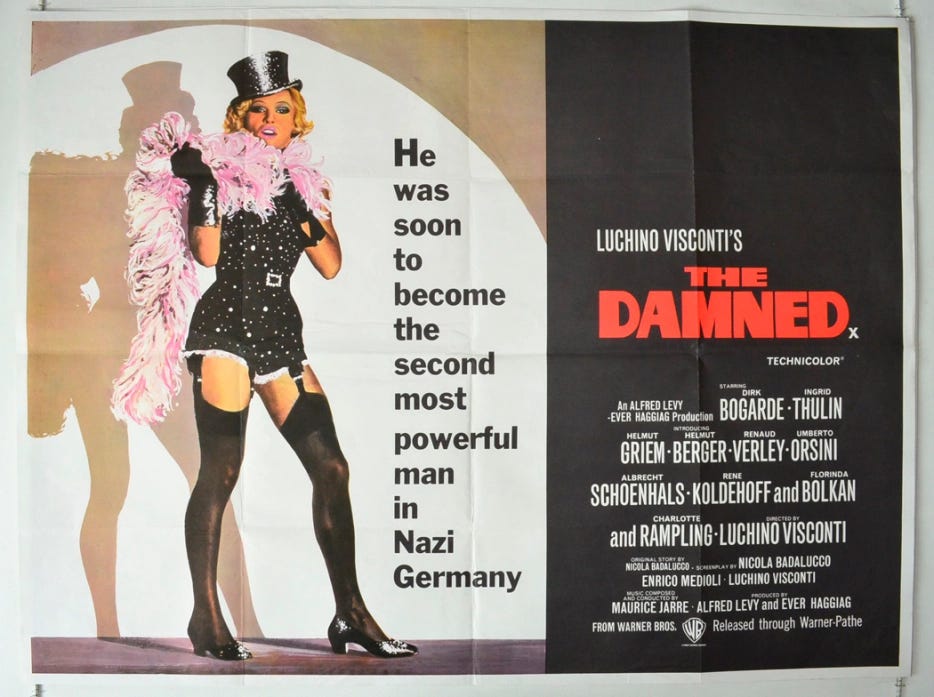
The night before I left Los Angeles to move to Rochester, NY for almost a year to study film preservation at the George Eastman Museum, I watched the Criterion disc of Luchino Visconti’s uber-decadent Nazi melodrama The Damned. I had hoped to spend my summer on a Visconti kick, ever since visiting his home in Ischia, Italy in early May. As it turned out, the four months between my return from Italy and my departure for Rochester were mostly taken up writing a new season of You Must
Remember This (release date TBD), and I didn’t get around to watching films for pleasure until that last week. Not that “pleasure” is the emotion that first comes to mind when thinking about The Damned. In fact, for the first week and a half or so that I spent in Rochester, I walked around with a burning asteroid of anxiety in my stomach, and it was impossible to sort out how much of it was caused by the massive life change I was embarking on, and how much of it was because of the movie, which continued to haunt me like a bad dream.
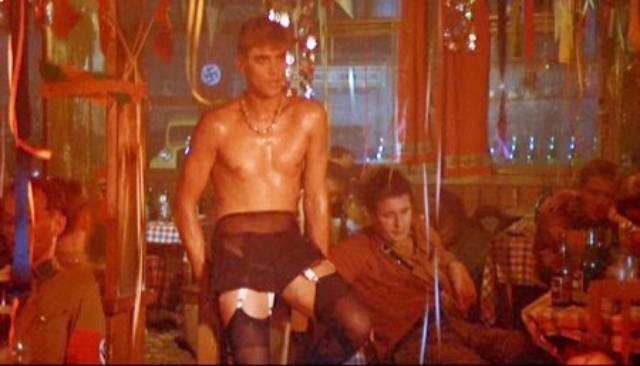
It seems clear that Visconti’s personal reason for making The Damned is the long sequence in the middle depicting the Night of the Long Knives purge at Bad Wiessee as a beyond-drunken, gay orgy that turns into a slaughter at the hands of the SS, here including two of Visconti’s fictional characters amongst the killers. But the historical event that kicks off the story is the Reichstag fire — an event widely invoked over the past few weeks in America in the aftermath of the assassination of Charlie Kirk. In Visconti’s film, when news of the fire interrupts a family talent show mounted to celebrate a German patriarch’s birthday, said patriarch decides to announce at dinner afterwards that he has no choice but to capitulate to the Nazi government and allow them to essentially commandeer the family steel business. Before the end of the night this patriarch will be murdered in order to frame, and force into exile, the one member of the family who opposes collaboration.
The Damned is bookended by images of a furnace burning in the steel factory. If it wasn’t clear the first time we see these flames, by the time it comes back around in the end — after we’ve every member of this family become either a Nazi true believer or a murder victim (sometimes first the former and then the latter), it’s clear these fires are a stand-in for the crematoria.
Perhaps one of the reasons The Damned haunted me for so long is that I kept being reminded of those flames. Much of the curiculum of the first couple of weeks of school had to do with the composition and combustibility of nitrate film — chemically speaking, cellulose nitrate, and thus the only film stock that can accurately be called celluloid, according to purists. In one class session, we were shown two nonfiction films back to back: in one, a crew of extremely Teutonic-looking post-war Austrians set a bunch of nitrate on fire in order to demonstrate that it cannot be extinguished by any conventional method of firefighting. In another, an industrial film from the 1920s showing the process of making nitrate stock at the Kodak factory, the then-current formula for making nitrate base was detailed. First step: dissolving cotton in acid. Once the plasticized base is finished, it is then spread with the emulsion that carries the silver particles that respond to light. This emulsion is bound to the base by gelatin, which then and now is made from melted animal bones. Today Kodak uses bi-products from the beef industry; one lecturer noted that they seek out bones from cows who eat mustard seeds, because the sulfur in the mustard results in better emulsion.
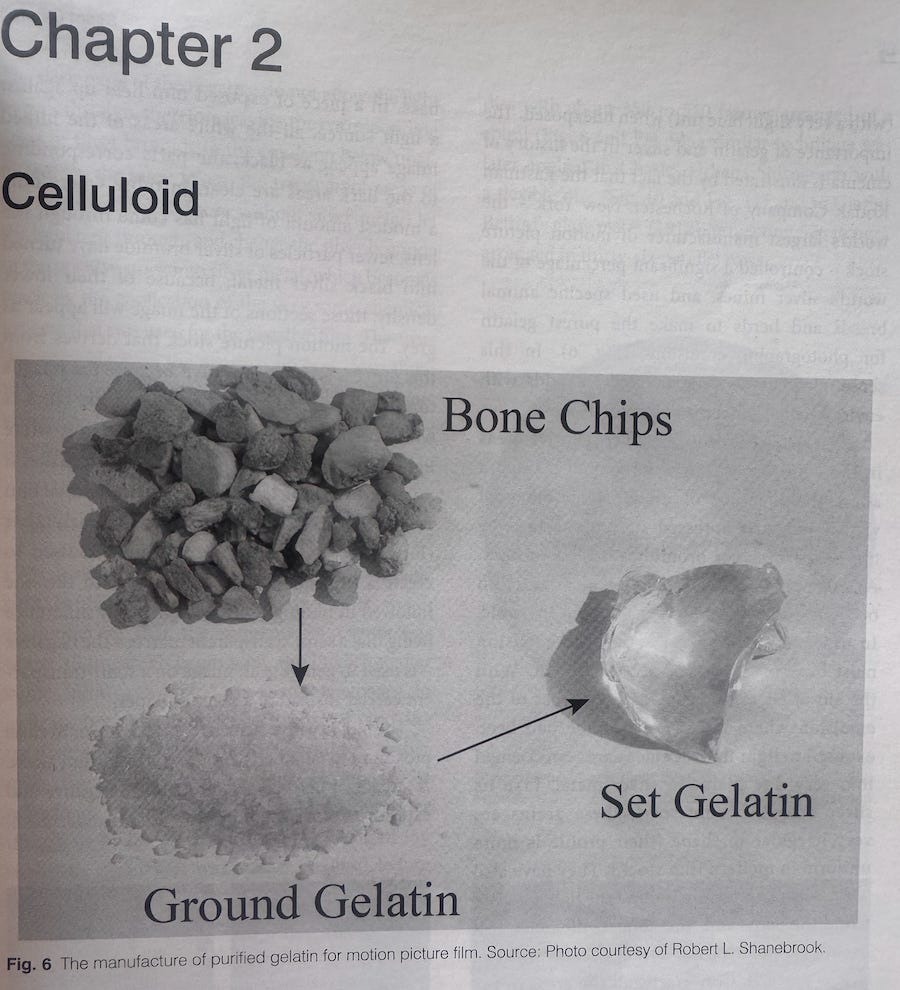
Most of this was news to me — particularly the fact that even in the year 2025, film stock cannot be made vegan. As Paolo Cherchi Usai writes in Silent Cinema (assigned in my program as a textbook, and authored by the founder of said program), as “the world’s largest manufacturer of motion picture stock,” Kodak “controlled a significant percentage of the world’s silver mines, and used specific animal breeds and herds to make the purest gelatin for photographic emulsions. In this sense, cinema was fundamentally at odds with environmental concerns and animal rights.”
Add to this the large amount of cotton initially required for film manufacture1, beginning in the late 1800s — barely a generation after the Civil War, a decade or so after the attempt at Reconstruction had dissolved and given way to Jim Crow, a time when cotton was hardly a racially unproblematic crop — and the dark secret history of film stock becomes impossible to ignore. Just as every Dutch painting of a certain era depicting boats or abundant still lives is secretly about slave trade, colonialism, the plunder by force of natural resources and other crimes committed in the name of economic expediency, every “film on film” is imbedded with invisible suffering, with uncomfortable details of a past that is not past. And this is before we get into the massive energy requirements of simply storing film with preservation in mind.
I was thinking about this while watching the Kodak factory film, which just then cut to a shot of smokestacks billowing over the factory. Obviously this industrial documentary was made years before the Nazis fired up the crematoria, and yet smokestacks are unavoidably as surefire a visual shorthand for mass death in my mental database as the furnaces seen in The Damned.
Where there’s smoke there’s fire, and there is smoke everywhere.
Since my arrival in Rochester, every Saturday afternoon the Museum’s cinematheque has been showing Clark Gable movies chosen to highlight his wide variety of female costars. I’ve often been out of town on the weekends, but I’ve made it to two of these screenings thus far: Dancing Lady, the fourth on-screen pairing of Gable and his longtime lover Joan Crawford, directed by the unfortunately under-sung Robert Z. Leonard; and Idiot’s Delight, a deceptively frothy Clarence Brown comedy featuring Gable and a bizarrely madcap Norma Shearer.
Both of these films were bowdlerized by the Hollywood censors, who, even before the Production Code’s regulations on sex and violence began to be enforced 1934, were already using their powers to help the studio execs maintain business-sustaining relationships with murderous world leaders by making sure American movies only commented on international affairs so obliquely that it was usually difficult to even decipher what they were trying to say. So, in Dancing Lady, a running gag involving the Three Stooges working on a jigsaw puzzle — only to snap in the final piece, realize the puzzle is a portrait of Hitler and knock the table and the puzzle with it to the floor in disgust — was cut from the theatrical version. (The person who introduced the screening I went to said the jigsaw puzzle gag has been restored to some prints and post-theatrical releases, but it was not in the version I saw.)
What was not cut from Dancing Lady is a sequence that perhaps more powerfully speaks to the cognitive dissonance of finding oneself dropped into a world in which a white supremacist leader’s promises to “fix everything” while demonizing the other are inexplicably believed and he is appeased. Not the finest of Crawford and Gable’s eight on-screen pairings, Dancing Lady’s virtues lie mainly in its subtly fantastic set design and its set-pieces, particularly the climactic musical sequence stacking high-concept, Busby Berkeley-esque surrealistic dance numbers, choreographed by Sammy Lee (Berkeley’s first truly iconic films, 42nd Street and Gold Diggers of 1933, were released the same year as Dancing Lady). About half way through this sequence, Crawford and Fred Astaire (making his film debut) find themselves dancing on a flying carpet soaring above the clouds. To their initial bewilderment, the carpet drops them in Bavaria — the region where the massacre of the SA by the SS depicted in The Damned would take place, in real life, seven months after Dancing Lady was released.
